How Does a Peanut Oil Production Line Operate?
This article explains the peanut oil production line operation from intake to packaged product, describes common peanut oil production line operation mode options, and outlines the standard peanut oil production line process used in modern plants. The content is tailored for international buyers and plant managers evaluating production systems or vendors such as QIE Group for turnkey solutions.
High-level overview: objectives and performance indicators
A commercial peanut oil production line must reliably convert raw peanuts into edible oil that meets food-safety and quality specifications while achieving targeted throughput, extraction yield, energy efficiency, and operating cost metrics. Typical performance indicators include daily throughput (tons/day), oil extraction rate (percentage by weight), overall recovery, utility consumption (steam/electricity), and labor hours per shift.
Modern systems—whether mechanical pressing, solvent extraction, or combined approaches—prioritize hygiene, automation, and ease of maintenance. When planning, most operators consider three scale categories: compact/entry, mid-scale, and industrial-turnkey, each with distinct capital expenditure and footprint profiles.
Peanut oil production line operation modes (continuous, batch, hybrid)
The peanut oil production line operation mode can be classified into three principal approaches:
- Continuous operation: Material flows continuously through cleaning, conditioning, extraction, and refining units. Best for high-capacity plants (industrial scale). Advantages: consistent product quality, higher utilization, predictable utility profiles.
- Batch operation: Operations proceed in discrete batches—common for small processors or specialty peanut oil production where variety and traceability are key. Easier to change settings between batches but less efficient at large scale.
- Semi-continuous / hybrid: Combines continuous feeding (e.g., cleaning and pressing) with batch steps (e.g., refining or some chemical treatments) to balance flexibility and throughput.
QIE Group supplies systems configured for each operation mode and advises on the best configuration based on capacity, product specification, and available utilities.
Detailed peanut oil production line process
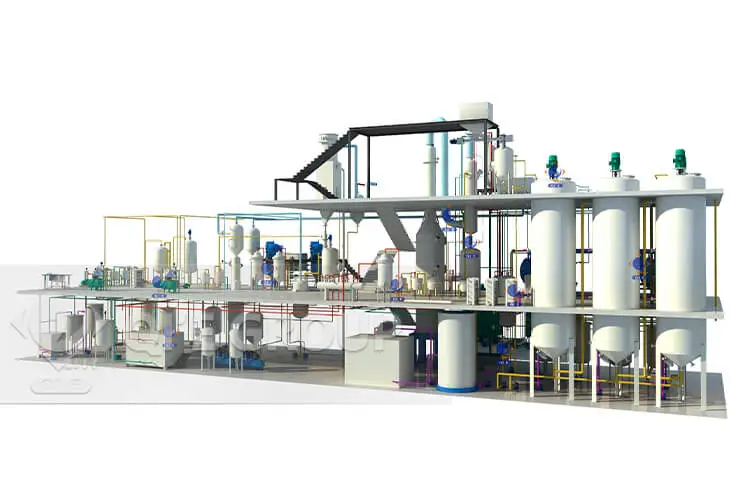
Below is a step-by-step description of the peanut oil production line process, with common equipment and key control points for quality and efficiency.
1. Raw material reception and quality control
Incoming peanuts are inspected for moisture, foreign matter, aflatoxin risk, and varietal consistency. Typical acceptance moisture is below 8–9% for storage stability. A receiving hopper, sampling station, and dry-cleaning separator are standard.
2. Cleaning and grading
Machines remove stones, soil, sticks, and broken shells. Air-screen and destoner units ensure that abrasive and heavy contaminants are eliminated to protect downstream equipment and final oil quality.
3. Dehulling and size reduction
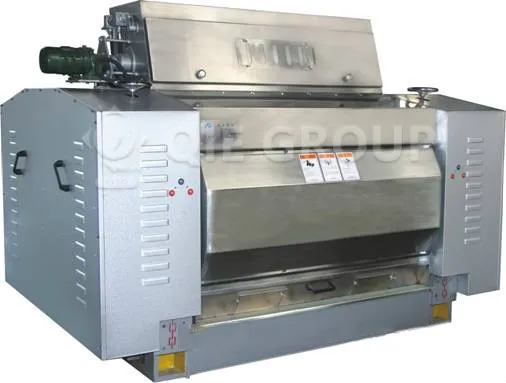
Dehulling (where required) and flaking reduce particle size to optimize oil recovery. Proper flake thickness and uniformity directly impact extraction efficiency. For some varieties, partial or full dehulling improves oil color and reduces impurities.
4. Conditioning
Conditioning (steam or thermal) adjusts temperature and moisture to enhance flake pliability and oil release. Controlled conditioning improves pressing performance and protects oil quality.
5. Extraction (mechanical pressing or solvent extraction)
Mechanical screw presses provide a solvent-free route favored for cold-pressed or specialty oils; typical oil yields are lower than solvent extraction but retain desirable flavor attributes. Solvent extraction (hexane or other approved solvents) achieves higher recovery for large-scale operations; the spent meal is then desolventized and toasted.
6. Oil refining stages
Crude peanut oil undergoes degumming, neutralization, bleaching, and deodorization to meet food-grade standards. These steps remove phospholipids, free fatty acids, pigments, and volatiles. Equipment includes neutralizers, bleaching earth filters, and vacuum deodorization columns.
7. Winterization and filtration
For clear, stable oil, winterization removes high-melting fractions that can cloud refrigerated oil. Final polishing filters ensure microbiological safety and clarity.
8. Packaging, storage and distribution
Filling lines for bottles, tins, or bulk containers are integrated with labeling, weighing, and palletizing. Proper nitrogen blanketing and temperature-controlled storage extend shelf life. Typical shelf-stable refined peanut oil meets international edible oil standards.

Key metrics and expected yields
Extraction yield and by-product value drive the plant economics. Typical figures (indicative):
- Peanut crude oil yield: approximately 40–50% of seed weight (varies by variety and process).
- Meal/cake protein: valuable feed product, typically 40–50% protein on a dry basis after solvent extraction or pressing with conditioning.
- Energy consumption: depends on scale and process; modern plants improve efficiency significantly—rough energy use often ranges from moderate to high depending on refining needs.
Capacity, footprint and indicative investment (guidance)
Plant selection aligns with target daily throughput and market strategy. Common capacity groupings:
| Scale | Typical throughput | Investment profile |
|---|---|---|
| Compact (entry) | Small batch: up to several tons/day | Lower capital commitment; suitable for artisanal or niche product lines. |
| Mid-scale | 10–50 tons/day | Moderate capital investment; balanced ROI potential for regional brands. |
| Industrial turnkey | 50+ tons/day | Significant capital expenditure; optimized for maximum recovery and low per-unit operating cost. |
Investment tends to scale non-linearly: selecting a mid-scale or industrial system reduces per-unit costs but requires stronger working capital and logistics. QIE Group can provide detailed CAPEX/OPEX estimates and plant layouts for feasibility studies.

Automation, control and quality assurance
Automation levels range from PLC-based controls for critical process variables (temperature, vacuum, flow) to full SCADA integration for plant-wide monitoring. Automation reduces variability, improves safety, and supports traceability required by export markets. In-line sensors and laboratory controls monitor free fatty acids, moisture, and sensory attributes.
Safety and environmental considerations
Solvent-based extraction demands solvent recovery systems, explosion-proof equipment, and robust process safety management. Effluent handling, dust control, and waste valorization (e.g., meal as feed or further processing) are essential to meet environmental regulations and improve overall plant economics.
Operational staffing and maintenance
Staff requirements depend on automation and scale. A compact line may need a small team (operators and maintenance), while an industrial plant requires shifts with specialized technicians, quality control staff, and logistics personnel. Planned preventive maintenance and spare parts inventory—particularly for wear parts like press screws and bearings—limit unplanned downtime.
Why choose QIE Group for your peanut oil production line?
QIE Group combines engineering experience with turnkey supply and after-sales services. Their offerings include layout design, equipment supply, installation supervision, commissioning, and operator training. For exporters and branded producers, QIE Group supports customization of refining streams to meet destination-specific standards and labeling requirements.
When evaluating suppliers, consider total cost of ownership (installation, utilities, consumables, maintenance), local service availability, and vendor track record in similar projects.