For investors planning to build a peanut oil processing plant,Peanut Oil Production Line Investmentthey should not compare only the equipment purchase price. The purchase price is a one-time expense, while oil yield, cake residual oil content, energy consumption, labor requirements, maintenance convenience, and process stability will continuously affect the plant’s long-term operating cost.
A peanut oil processing line usually consists of a pre-treatment section and a pressing section. Whether pre-treatment is sufficient affects pressing efficiency; whether the pressing equipment runs stably affects continuous production, oil filtration, and cake condition. Therefore, comparing the quotation of a single machine alone often cannot reflect the actual return of the entire production line.
It reflects the initial investment at the equipment procurement stage, which is useful for quick budget comparison, but it cannot independently represent long-term costs.
It includes energy consumption, labor, wear parts, maintenance downtime, raw material loss, filtration efficiency, and process stability.
It depends on the long-term operating performance of the equipment rather than only the price figure in the procurement contract.
A peanut oil processing plant usually includesPeanut oil pretreatment machineandPeanut Oil Press. Proper pre-treatment can improve the stability of subsequent pressing and reduce the impact of impurities, iron contaminants, stones, and other foreign matter on equipment and oil quality.
peanut kernels → 清理 → magnetic separation → destoning → Crushing → flaking → Steaming and stir-frying → pre-pressing → Steaming and stir-frying → Secondary pressing → filter → deacidification and drying → Canned
The cake after secondary pressing can enter the cake cooling and cake storage section, which is convenient for subsequent storage or comprehensive utilization.
| Evaluation factor | Impact on operating cost | Key points to check when purchasing |
|---|---|---|
| Oil yield | It directly affects the amount of oil obtained per unit of raw material and is an important variable in oil plant revenue calculations. | Whether pre-treatment is uniform and whether the cooking temperature and moisture control are suitable for pressing. |
| Cake Residual Oil Rate | A higher residual oil content means oil remains in the cake meal, which may affect raw material utilization. | Whether the configuration of the screw oil press, pre-press, and secondary pressing matches the project objectives. |
| Energy consumption | Power and heat consumption accumulate over time, especially in continuous production scenarios. | Whether the equipment power configuration, heating method, material conveying, and process continuity are reasonable. |
| Labor configuration | Ease of operation and automation level affect the number of operators, training costs, and management complexity. | Whether the control method, residue discharge method, filtration continuity, and daily operation are simple. |
| Maintenance and downtime | Maintenance frequency, replacement of wear parts, and downtime affect actual output. | Whether the structure is stable, whether spare parts supply is available, and whether after-sales service can support long-term operation. |
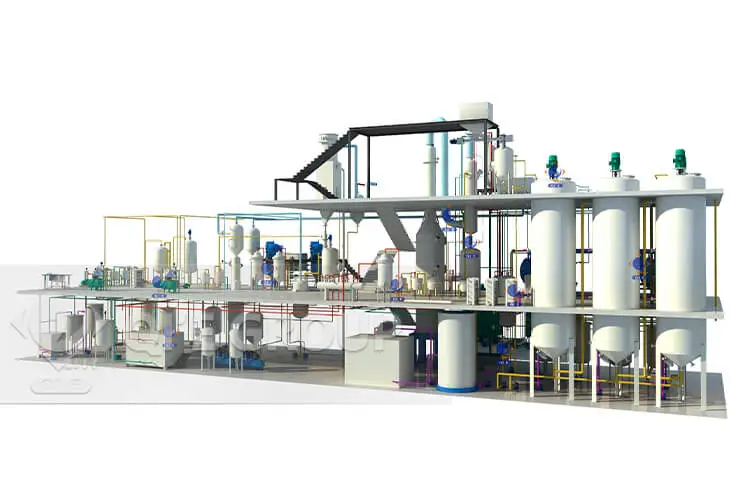
A peanut oil production line is not simply a combination of individual machines. Cleaning, impurity removal, crushing, cooking, pressing, and filtration must be matched with one another to form a stable production rhythm.
| Device Name | Role in the production line | Key concerns related to investment return |
|---|---|---|
| Peanut Shelling Machine | It is composed of a feed hopper, ribbed roller, concave screen, fan, specific-gravity separation screen, and pneumatic conveyor, and is used for peanut shelling. | Compact structure, stable operation, processing capacity, and power consumption all affect pre-treatment efficiency; shelling rate is no less than 95%. |
| Cleaning Sieve | Used to remove large and small impurities and improve production stability and the working environment. | Cleaning performance affects downstream equipment wear, oil impurities, and continuous production status. |
| Magnetic separator | Equipped with a non-powered magnetic separator to remove ferrous impurities. | Reduces the risk of metal impurities entering the crusher, flaking machine, and oil press. |
| Gravity Destoner | Uses suction-type specific-gravity destoning to remove stones and clods of mud. | Reduces the impact of hard impurities on downstream equipment and helps lower maintenance costs. |
| Toothed Roll Crusher | Crushes peanuts evenly, usually into 4-8 pieces, making them easier to soften and cook. | The uniformity of the crushed particle size affects temperature distribution, moisture distribution, and subsequent pressing performance. |
| Steaming pan | Adjusts the moisture and temperature of peanuts to bring them into a condition suitable for pressing. | Moisture and temperature control affect oil yield, cake condition, and pressing stability. |
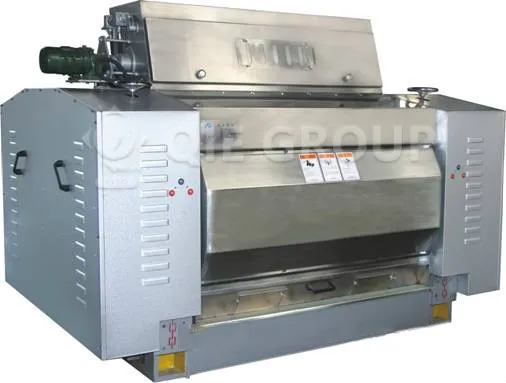
| Embryo Press | Prepare the material to a thickness of about 0.3 mm, which facilitates subsequent processing. | Flake thickness and uniformity affect oil release efficiency; in solvent extraction processes, they help reduce residual oil in the meal. |
| Screw pre-press | Suitable for first pressing of vegetable oilseeds such as peanuts, rapeseed, soybeans, and sunflower seeds, and is ideal for materials with higher oil content. | Pre-pressing performance affects the load of secondary pressing and overall oil recovery. |
| Screw oil press | Applicable to peanuts, rapeseed, soybeans, sunflower seeds, and other oilseeds, equipped with micro-electric control, infrared heating, and multi-stage pressing, suitable for hot pressing or cold pressing. | Pressing stability, heating method, and maintenance convenience are important factors affecting long-term operating cost. |
| Vertical Leaf Filter | Uses a thickened stainless-steel mesh screen to remove coarse and fine residues from the oil and allows automatic residue discharge. | Filtration efficiency and continuous operation capability affect subsequent fine filtration, labor intensity, and oil processing efficiency. |
For overseas and domestic B2B buyers, oil mill investors, and grain and oil processing enterprises, a more practical approach is to evaluate the quotation together with the production targets. Peanut raw materials in different regions vary in oil content, moisture, impurity ratio, electricity cost, labor cost, and after-sales support, so the production line solution should also be adjusted accordingly.
Delivery of peanut oil processing equipment includes not only the machines themselves, but also process design, production line matching, installation and commissioning, and after-sales support. For cross-border procurement, service responsiveness and technical communication capability directly affect project implementation efficiency.
Configure cleaning, crushing, cooking, pressing, and filtration equipment according to raw materials, capacity, and finished product requirements to avoid mismatch in single-machine capacity.
Commissioning after production line installation affects equipment startup, material flow, pressing stability, and filtration performance.
Long-term operation requires support for spare parts, operating guidance, and maintenance recommendations, especially for overseas projects in Asia, Africa, and South America.
A quotation with real reference value should not only list equipment names and unit prices. Buyers should also confirm each machine’s role in the process, scope of configuration, material specifications, control method, installation conditions, wear parts, and after-sales service boundaries.
If you are comparing peanut oil processing equipment prices, please also provide the raw material, capacity, plant conditions, and finished product target. Zhengzhou QIE Grain and Oil Machinery Co., Ltd can help you analyze the configuration of pre-treatment, pressing, and filtration according to your project needs.
Common configurations include a peanut sheller, cleaning sieve, magnetic separator, specific-gravity destoner, tooth-roller crusher, cooking pan, flaking machine, screw pre-press, screw oil press, and vertical leaf filter. The specific configuration should be determined according to the raw material condition, capacity, and finished product requirements.
The purchase price only reflects the initial investment. The oil yield, residual oil content in the cake meal, energy consumption, labor arrangement, maintenance frequency, and downtime after operation all affect long-term operating costs and investment return.
The pre-treatment section includes cleaning, magnetic separation, destoning, crushing, flaking, and cooking. The more stable the pre-treatment, the easier it is to bring material particle size, moisture, and temperature to a condition suitable for pressing, thereby supporting a more stable pressing process.
A screw pre-press is suitable for first pressing of materials with higher oil content. A screw oil press can be used for peanuts, rapeseed, soybeans, sunflower seeds, and other oilseeds, and can support hot pressing or cold pressing according to process requirements. Whether to adopt pre-pressing plus secondary pressing should be determined based on capacity, raw material characteristics, and the oil plant’s objectives.
It is recommended to provide the raw material type, target capacity, plant conditions, local energy conditions, preferred process route, finished oil requirements, and whether further refining configuration is needed. The more complete the information, the easier it is for the supplier to provide a more suitable equipment solution.