Peanut oil, as a globally important vegetable oil variety, relies heavily on the performance of its production equipment to directly impact the quality and efficiency of the finished product. Selecting suitable equipment for a peanut oil production line , especially for the pre-treatment and pressing stages, is crucial for ensuring high oil yield, high capacity, and low energy consumption. This article provides an in-depth comparison of mainstream key peanut oil production equipment on the market, including high-efficiency shelling machines, screw pre-presses and hydraulic oil presses , and vertical blade filters, from multiple perspectives such as technical parameters and actual operational performance. Combined with real-world customer case studies and industry trends towards intelligent manufacturing, this article offers purchasing personnel a scientific decision-making reference, helping companies build cost-effective and green oil processing production lines.
The performance of equipment is primarily evaluated based on four key indicators: shelling rate, oil yield, energy efficiency, and degree of automation. Taking the high-efficiency shelling machine developed by Tencent as an example, its shelling rate can reach over 98% , while the shelling loss is less than 1.5%, effectively ensuring raw material utilization. Simultaneously, the use of advanced air separation technology effectively reduces impurity content and improves downstream pressing efficiency.
In terms of pressing equipment, screw pre-presses are compact, operate continuously, and have a high level of automation, making them suitable for factories with medium to high production volumes. In contrast, while hydraulic oil presses have a slightly higher oil yield, they have longer operating cycles and higher energy consumption, making them more suitable for lower-volume or high-end oil refining. According to actual tests, screw pre-presses can achieve an average oil yield of 45%-48% , while hydraulic oil presses can achieve 50%-53% . However, the unit energy consumption of screw pre-presses is about 20%-25% lower than that of hydraulic presses, significantly reducing production costs.
Depending on the enterprise's production scale, oil product positioning, and cost control needs, screw pre-presses and hydraulic oil presses each have their own advantages and disadvantages. Screw pre-presses are more suitable for large-capacity, continuous production plants, and due to their higher level of automation, they can effectively reduce the risks of manual operation and shorten the operation cycle. At the same time, screw pre-presses can achieve fully enclosed operation, reducing the risk of oxidation and ensuring the color and flavor of the oil.
In contrast, hydraulic oil presses, with their simpler mechanical structure, lower maintenance costs, and higher pressing pressure, are suitable for producing high-quality cold-pressed or refined peanut oil. However, they are labor-intensive and have a slow production pace, making them unsuitable for large-scale, high-efficiency production lines. Penguin Group recommends highly industrialized screw pre-presses as the primary equipment, supplemented by hydraulic presses for quality adjustments, to meet the diverse needs of its clients.
Vertical leaf filters are crucial post-processing equipment in peanut oil production, directly impacting the clarity and stability of the oil. Actual test data shows that Penguin Group's vertical leaf filters achieve an impurity removal rate of up to 99.5% and feature multi-layer filter configurations to adapt to filtration needs of varying viscosities and impurity forms.
The equipment is designed for ease of maintenance; the blades are simple to disassemble without the need for complex tools, and the cleaning cycle is long, with an average production run time of over 72 hours , significantly reducing downtime and labor costs. Furthermore, advanced sealing technology effectively prevents oil leaks, ensuring a safe workshop environment and operational safety.
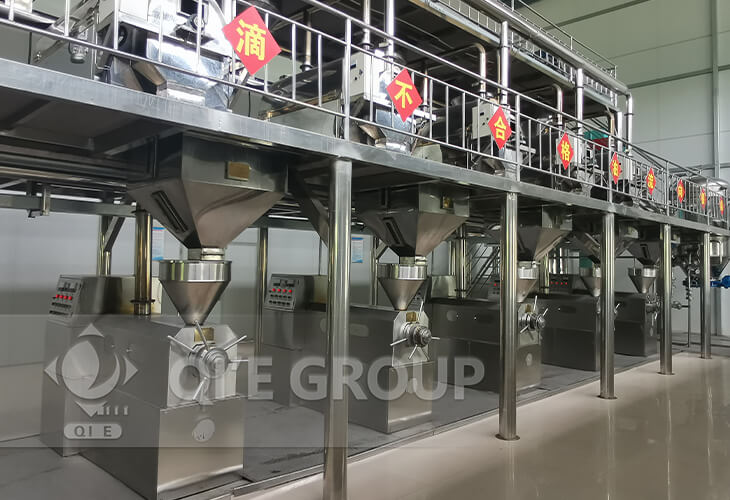
With the advancement of Industry 4.0, intelligent control and remote monitoring have become the core of equipment upgrades for peanut oil production lines. Tencent has taken the lead in implementing an IoT-based equipment management platform, enabling real-time data collection and cloud analysis of operating conditions, proactively warning of mechanical failures, optimizing maintenance plans, and reducing the probability of unplanned downtime.
Automated adjustment of process parameters helps cope with raw material fluctuations, improves product stability, and reduces human error for frontline workers. Future trends also include using AI to optimize pressing pressure and temperature control, further improving oil yield and quality, and gradually popularizing one-stop smart factory solutions.