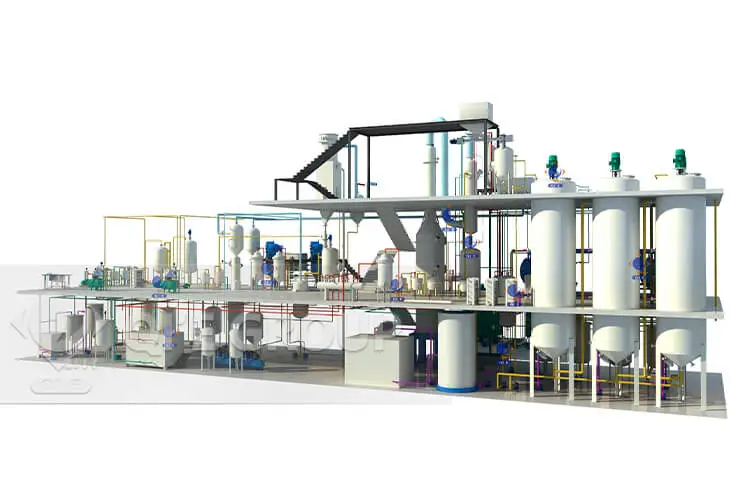
While traditional peanut oil production lines favor mechanical pressing methods for their flavor retention, this method often leaves a significant amount of oil in the cake.
Larger peanut oil production lines using mechanical pressing methods suffer from significant oil loss. To achieve industrial-grade production efficiency, QIE GROUP employs an integrated solution combining peanut oil press and solvent extraction. By combining mechanical power with precision chemical extraction, we help manufacturers reduce residual oil content in the oil cake to below 0.5%.
1. Efficient pretreatment can improve oil yield.
Our pretreatment stage focuses on cell disruption to prepare peanuts for maximum oil release. QIE group tests have shown that pretreated peanuts have an oil yield that is over 30% higher than untreated peanuts.
The pretreatment production line goes through these operations:
Cleaning and destoning: High-frequency vibrating cleaning screens, destoners, and magnetic separators are used to ensure that peanuts are free of debris, protecting downstream edible oil processing equipment from wear and tear.
Conditioning and crushing: Advanced vertical conditioning tower and toothed roller crusher are used to optimize the moisture and temperature of the material. After these operations, the peanuts reach the best oil extraction state.
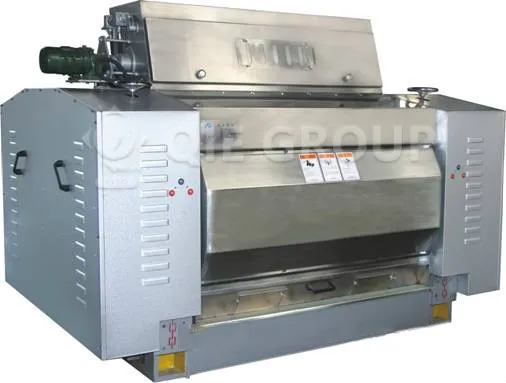
Rolling and Extrusion: Heavy-duty rolling mills reduce material to sheets of 0.3-0.5 mm, while extrusion extruders create porous structures, greatly increasing the contact surface area of solvent extraction equipment.
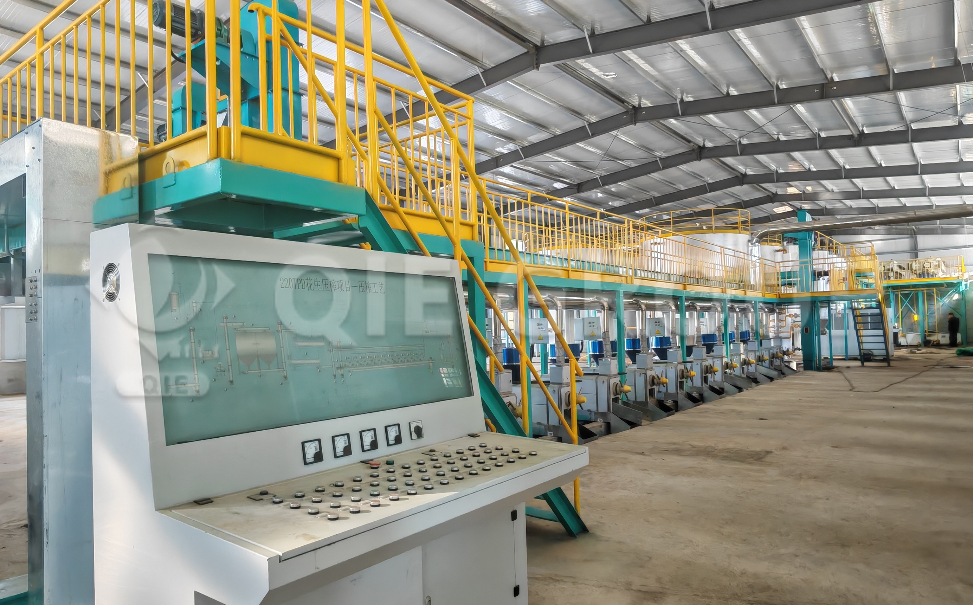
2. Optimized pre-pressing: Balancing flavor and efficiency
For commercial peanut oil production lines, we first use high-capacity screw presses to produce oil from peanuts for the first time.
1. Approximately 60-80% of the oil is extracted mechanically. Peanut oil extracted by pressing can preserve its flavor.
2. After being pressed by an oil press, the residual oil content of peanut oil cake is usually between 12-18%, and these oil cakes can be extracted.
3. Advanced solvent extraction effectively reduces the residual oil content in peanut cake.
The 12-18% oil in peanut cake can be further processed into oil using a solvent extraction production line. First, the pre-pressed cake is fed into our solvent extraction equipment:
Countercurrent extraction: This method uses a rotary or annular extractor to bring the material into countercurrent contact with the solvent (n-hexane). This method maximizes the concentration of the mixed oil while reducing the amount of solvent used.
Steam desolventizing, drying, and cooling: Our DTDC system processes wet peanut meal while removing solvents and preserving the protein content of the peanut meal. The remaining peanut meal can be used as a high-value feed ingredient.
Solvent recovery: Our fully enclosed negative pressure system enables a solvent recovery rate of ≥ 99.9%, reducing solvent loss per ton of raw material to approximately 1.5 kg.

4. Why can this method better improve the oil yield?
By selecting integrated peanut oil press and solvent extraction processes, large-scale peanut oil production line users can increase peanut oil yield by an average of 12-15% compared to independent pressing methods. Furthermore, our updated heat recovery system employs multi-effect evaporation technology, reducing total steam energy consumption by 10-15%. Utilizing QIE group's latest patented technology, users can reduce energy efficiency while achieving environmental protection.
QIE GROUP provides turnkey projects for peanut production lines, and can adjust the production line according to user requirements to help users reduce costs for peanut oil pre-pressing and extraction plants.
Frequently Asked Questions about Peanut Oil Pre-pressing and Extraction
1. What is the typical residual oil rate of a professional peanut oil production line?
In specialized, integrated processing plants, the residual oil content in the meal can typically be reduced to below 0.5%. In contrast, simple mechanical pressing usually leaves 5-8% oil in the cake.
2. How does solvent extraction equipment ensure product safety?
The system operates in a fully enclosed negative pressure environment. The advanced stripping tower ensures that the residual solvent in the crude oil is below 50 ppm, and the residual solvent in the finished meal is below 100 ppm, fully complying with international food safety standards.
3. Does solvent extraction affect the quality of peanut oil?
No. The blended oils undergo multi-effect evaporation and vacuum stripping at controlled temperatures to completely remove solvents without damaging the fatty acid composition of the oils. Subsequent refining processes further ensure the stability, high quality, and purity of the finished oil.
4. What are the benefits of the "expansion" process in pretreatment?
The puffing machine uses high pressure and steam to turn peanut flakes into porous "granules." This increases the bulk density and improves solvent permeability, thereby increasing the capacity and extraction efficiency of solvent extraction equipment.
5. Are peanut oil press and solvent extraction processes environmentally friendly?
Yes. Modern plants are equipped with exhaust gas absorption systems and refrigeration recovery units, which can capture almost all solvent vapors. With a solvent recovery rate of 99.9%, environmental impact and operating costs are kept to extremely low levels.