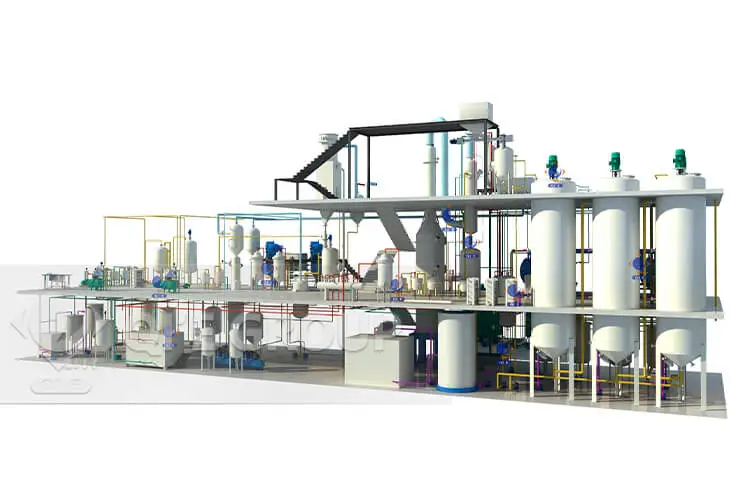
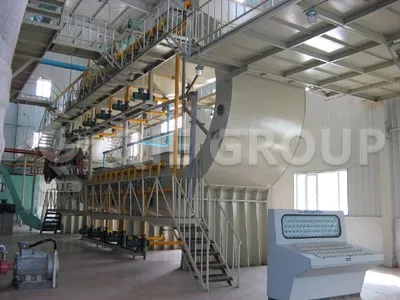
Producing Grade 1 peanut oil requires more than simple pressing. It depends on a defined peanut oil refining process that removes gums, free fatty acids, pigments, and unwanted odor compounds while keeping the oil stable and suitable for the target market. For buyers comparing aromatic peanut oil with fully refined peanut oil, the key difference is not only equipment selection, but also how far the refining stages are taken.
Based on the technical approach of QIE Group, this page explains the four refining stages used in a peanut oil refining line: degumming, deacidification, decolorization, and deodorization. It also shows where these stages fit within a complete peanut oil production line, and what purchasing factors should be reviewed before choosing plant configuration.
Peanut has a relatively high oil content, typically around 45–55%. Because of this, factories usually choose between two broad production routes depending on product positioning, output scale, and return expectations.
Typical flow: cleaning → crushing → high-temperature cooking → screw press or hydraulic press → crude oil filtration → mild treatment or cold filtration → packing.
This route focuses on rich roasted peanut aroma. It is suitable for premium flavored oil, but it is not the standard route for Grade 1 peanut oil because full deodorization is intentionally avoided to preserve aroma compounds.
Typical flow: cleaning → crushing → cooking → pre-pressing → solvent extraction → crude oil → degumming → deacidification → decolorization → deodorization → packing.
This is the main route when the goal is Grade 1 refined peanut oil, large-scale output, and higher overall oil recovery with stable product quality.
In a complete four-stage peanut oil refining process, each step has a specific role. Together, these stages convert crude peanut oil into a cleaner, more stable edible oil that can meet standard Grade 1 requirements, depending on raw material quality and process control.
Purpose: Remove phospholipids, gums, and colloidal impurities from crude oil.
How it works: Hydration or acid treatment is used to make gum-like impurities separable, usually followed by centrifugal separation.
Main equipment: degumming tank, acid or water dosing system, degumming centrifuge, intermediate oil tank. This stage prepares the oil for downstream refining and helps reduce later processing difficulties.
Purpose: Reduce free fatty acids to improve oil quality and support compliance with finished oil standards.
How it works: This can be done by alkali neutralization or by physical distillation, depending on line design and quality target.
Main equipment: neutralization vessel or vacuum deacidification tower, dosing system, separator, soapstock handling section. For Grade 1 oil, deacidification is a necessary stage rather than an optional treatment.
Purpose: Remove pigments and part of the trace impurities that affect appearance and oxidation stability.
How it works: Activated bleaching earth adsorbs pigments and selected contaminants, followed by filtration.
Main equipment: bleaching tank, vacuum system, metering device for bleaching earth, high-efficiency leaf filter or pressure filter. This stage is important for producing bright, clear refined peanut oil.
Purpose: Remove odor-active compounds, residual volatiles, and part of the peroxide-related unstable substances.
How it works: High-temperature steam stripping under high vacuum separates unwanted volatile compounds from the oil.
Main equipment: vacuum deodorization tower, steam system, heat exchangers, vacuum unit, condensate collection section. This is the critical stage that clearly separates fully refined Grade 1 peanut oil from aromatic peanut oil.
Many buyers ask whether the same refining line can produce both aromatic peanut oil and Grade 1 refined peanut oil. The answer depends on process boundary. Some front-end equipment may be shared, but the refining depth and especially the deodorization decision are fundamentally different.
| Process Item | Aromatic Peanut Oil | Grade 1 Peanut Oil |
|---|---|---|
| Product goal | Rich peanut aroma, deeper color, premium flavor profile | Clean taste, bright color, stable quality, standard refined oil |
| Degumming | Usually mild treatment or cold filtration only | Full degumming required |
| Deacidification | Often omitted or minimized to preserve flavor components | Required for standard refined oil quality |
| Decolorization | Usually skipped or kept very light | Required for clearer finished oil |
| Deodorization | Not used, because aroma would be stripped out | Core process stage |
| Best-fit market | Premium flavor oil, gift market, specialty retail | Retail cooking oil, food service, standard edible oil supply |

A refining line is not only a sequence of tanks. Stable production depends on correct equipment matching between crude oil quality, output target, and automation level. A typical peanut oil refining production line may include the following units:
| Section | Typical Equipment | Role in the Process |
|---|---|---|
| Pre-treatment | Cleaning sieve, destoner, magnetic separator, cooker | Prepare uniform raw material for pressing or pre-pressing |
| Pressing | Screw oil press, hydraulic oil press, pre-press machine | Mechanical oil extraction or cake preparation for extraction |
| Extraction | Loop extractor, drag chain extractor, rotary extractor, DTDC desolventizer | Deep oil recovery from pre-pressed cake in larger plants |
| Refining | Degumming centrifuge, deacidification tower, bleaching tank, filter, deodorization tower | Upgrade crude oil into standard refined edible oil |
| Utilities & recovery | Vacuum system, steam system, condensers, tail gas recovery unit | Support safe, energy-efficient, and stable plant operation |

When selecting edible oil degumming and deacidification equipment or a complete peanut oil refining line, the right decision should be based on plant objectives rather than equipment price alone.
| Decision Factor | Aromatic Pressing Route | Pre-press + Extraction + Full Refining |
|---|---|---|
| Main product position | Premium flavor oil | Standard Grade 1 edible oil |
| Core value | Natural aroma retention | Higher total oil recovery and production efficiency |
| Investment level | Lower initial equipment investment | Higher initial investment due to extraction and full refining sections |
| Process complexity | Moderate | Higher, with more utility and safety requirements |
| Best for | Brand differentiation through flavor | Large-volume, efficiency-focused edible oil production |
If your commercial target is standard Grade 1 peanut oil, deodorization is not optional. If your commercial target is aromatic peanut oil, deodorization should be avoided because it removes the characteristic peanut aroma that defines the product.
QIE GROUP provides peanut oil processing solutions covering pre-treatment, pressing, extraction, refining, installation support, commissioning, and after-sales service. For customers in Asia, Africa, and South America, QIE Group focuses on matching process depth and equipment configuration to local product demand, capacity planning, and plant operating conditions.
If you are comparing how to produce Grade 1 peanut oil versus how to build an aromatic peanut oil business, a practical first step is to define your target market, daily tonnage, utility conditions, and whether continuous refining is required. That information determines the right combination of refining towers, filters, separators, vacuum systems, and front-end oil extraction equipment.
Some front-end sections such as cleaning, crushing, and pressing may overlap, but the refining path is different. Grade 1 peanut oil requires full refining including deodorization, while aromatic peanut oil should not go through deodorization if aroma retention is the goal.
The four main stages are degumming, deacidification, decolorization, and deodorization. Together, they remove gums, free fatty acids, pigments, and unwanted odor compounds from crude peanut oil.
Typical packages may include a degumming tank, dosing system, centrifuge, neutralization or deacidification vessel, vacuum section, pumps, intermediate tanks, and control system. The exact configuration depends on capacity and process route.
This route is usually preferred for larger-capacity projects where higher total oil recovery and lower per-ton raw material cost are priorities. It is also suitable when the final product is fully refined peanut oil rather than premium aromatic oil.
Yes, for smaller projects it can be a practical option. According to the provided process scope, batch refining may be considered for capacities of up to 30 TPD, while larger plants often prefer continuous refining for more stable operation and efficiency.